Onyx in Antique Jewelry: Origins, Symbolism, and Its Leading Role in Art Deco
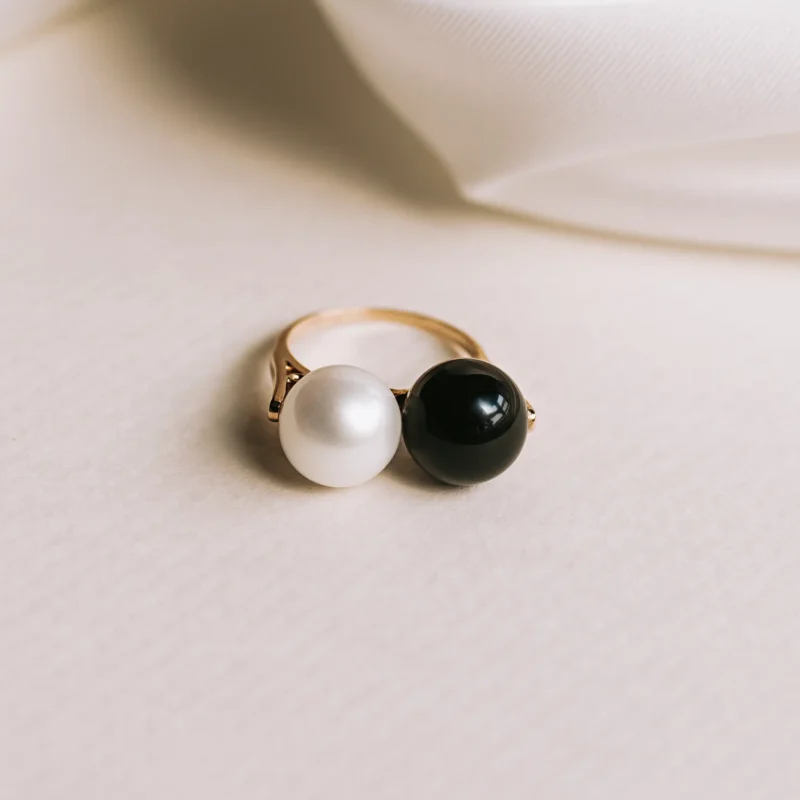
perla y onix

Onyx is one of the most iconic gemstones in antique and vintage jewelry, especially recognized for its elegant deep black color and its strong presence in Art Deco jewelry from the 1920s and 1930s. Used since Antiquity in rings, earrings, brooches, and cameos, onyx has historically symbolized protection, strength, and sophistication. In Art Deco jewelry, this semi-precious gemstone gained special prominence thanks to its striking geometric contrasts with diamonds, platinum, and enamel, becoming a defining element of vintage high jewelry design. Today, antique onyx jewelry is highly valued by collectors and jewelry enthusiasts for its timeless aesthetics, rich history, and strong association with luxury and classic elegance.

The History and Origins of Onyx in Jewelry

Onyx is one of the most recognizable gemstones in the history of jewelry. Its intense black color, understated shine, and ability to create dramatic contrast have made it a prized material for centuries in rings, earrings, cameos, and decorative jewelry pieces.

Although today it is closely associated with vintage jewelry and the Art Deco style, the use of onyx dates back much further. Ancient civilizations such as the Egyptians, Greeks, and Romans used onyx and sardonyx to carve seals, amulets, and cameos. In fact, the word “onyx” comes from the Greek onyx, meaning “fingernail,” a reference to the natural bands found in some varieties of the stone.

From a gemological perspective, onyx belongs to the chalcedony family, a microcrystalline variety of quartz mainly composed of silicon dioxide (SiO₂). Traditionally, natural onyx displays parallel bands of different colors, although black onyx became the most popular type in jewelry from the 19th century onward.

Onyx in 19th Century Jewelry

During the Victorian era, onyx played an especially important role in mourning jewelry. After the death of Prince Albert in 1861, Queen Victoria popularized a sober and dark aesthetic that deeply influenced European jewelry design.

Onyx quickly became a common choice for brooches, pendants, and rings associated with remembrance and mourning. Unlike brighter or more colorful gemstones, onyx conveyed restraint, elegance, and emotional depth, making it ideal for sentimental jewelry with symbolic meaning.

Many of these antique pieces also incorporated pearls, black enamel, or rose-cut diamonds, all characteristic elements of late 19th-century antique jewelry.

The Rise of Onyx in Art Deco Jewelry

It was during the 1920s and 1930s that onyx reached one of the most iconic moments in jewelry history.

The Art Deco movement embraced geometric lines, bold visual contrasts, and highly defined color combinations. In this context, onyx fit perfectly. Its deep black tone enhanced the brilliance of diamonds and emphasized the symmetrical structures that defined the era.

Rigid bracelets, geometric earrings, cocktail rings featuring calibrated onyx and diamonds — many of the most representative Art Deco jewelry pieces incorporated onyx precisely because of its strong graphic presence.

Today, onyx remains one of the most recognizable gemstones in vintage jewelry from the 1920s and 1930s. At Urbieta Antique, onyx frequently appears in Art Deco earrings, bracelets, and cufflinks, where the timeless contrast between black and white still feels remarkably contemporary.

How to Identify Antique Onyx Jewelry

In antique jewelry, onyx is commonly found in:

  • Polished cabochons
  • Geometric plaques
  • Carved cameos
  • Combinations with diamonds, pearls, or sapphires

Original Art Deco pieces typically feature highly precise cuts and an architectural integration of the stone within the design. Onyx was not used merely as decoration, but as an essential part of the geometric composition itself.

It is also common to find onyx in men’s cufflinks and signet rings from the early 20th century, particularly crafted in white gold, platinum, or yellow gold.

A Stone That Continues to Find Its Owner

There is something unique about antique onyx jewelry: it rarely goes unnoticed. Perhaps because it has such a strong personality, or because it tends to attract people searching for timeless and distinctive pieces rather than obvious luxury.

Some time ago, a client visited the store looking for “something Art Deco, but different.” She tried on several pieces before stopping at a pair of 1930s onyx and diamond earrings. They were not the largest or the brightest, but once worn, they were unquestionably the most striking.

She hesitated too long.

When she returned a few days later, the earrings had already been sold.

Interestingly, weeks later she came back again — this time wearing those exact earrings. Her partner had purchased them without knowing she had previously come to see them.

This happens more often than one might think in antique jewelry: certain pieces create an immediate emotional connection. And onyx, perhaps because of its visual strength and its historical role in vintage design, often produces that effect.

Some gemstones stand out because of their brilliance.

Others, like onyx, endure because of their character.

Faqs about onyx in antique jewelry

Onyx has historically symbolized protection, strength, elegance, and emotional balance. In antique jewelry, it was also associated with mourning, introspection, and refined sophistication.
Onyx perfectly matched the geometric and sophisticated aesthetic of the Art Deco movement. Its deep black color created dramatic contrasts with diamonds, platinum, and enamel, all signature elements of 1920s and 1930s jewelry.
Antique onyx jewelry often features precise craftsmanship, handmade settings, and materials such as gold, platinum, or old-cut diamonds. In Art Deco pieces, onyx is usually integrated into strong geometric designs.
Yes. Onyx belongs to the chalcedony family, a variety of quartz. Although some stones are treated to enhance their black color, onyx itself is a natural gemstone that has been used in jewelry for centuries.
Because it combines history, timeless design, and strong visual character. Onyx remains one of the most elegant and versatile gemstones in vintage and collectible jewelry today.
Al continuar navegando en esta página, autorizas a Urbieta al uso de cookies, para más información consulta la política de cookies.