

Jewelry
The Ruby: History, Meaning and Antique Jewellery Featuring One of the Most Fascinating Gemstones

Aug
The ruby is a red precious gemstone belonging to the corundum family, whose distinctive colour is primarily caused by the presence of chromium. Valued for its rarity, hardness and symbolism associated with love, passion and power, it has featured in some of the most remarkable creations in the history of jewellery. At Urbieta Antique, we select antique and vintage ruby jewellery, including rings, earrings and brooches, for the quality of its gemstones, authenticity, craftsmanship and uniqueness.
However, talking about rubies also means talking about nuance. Not all rubies have the same colour, transparency, origin or characteristics, and it is precisely these differences that make each stone unique.
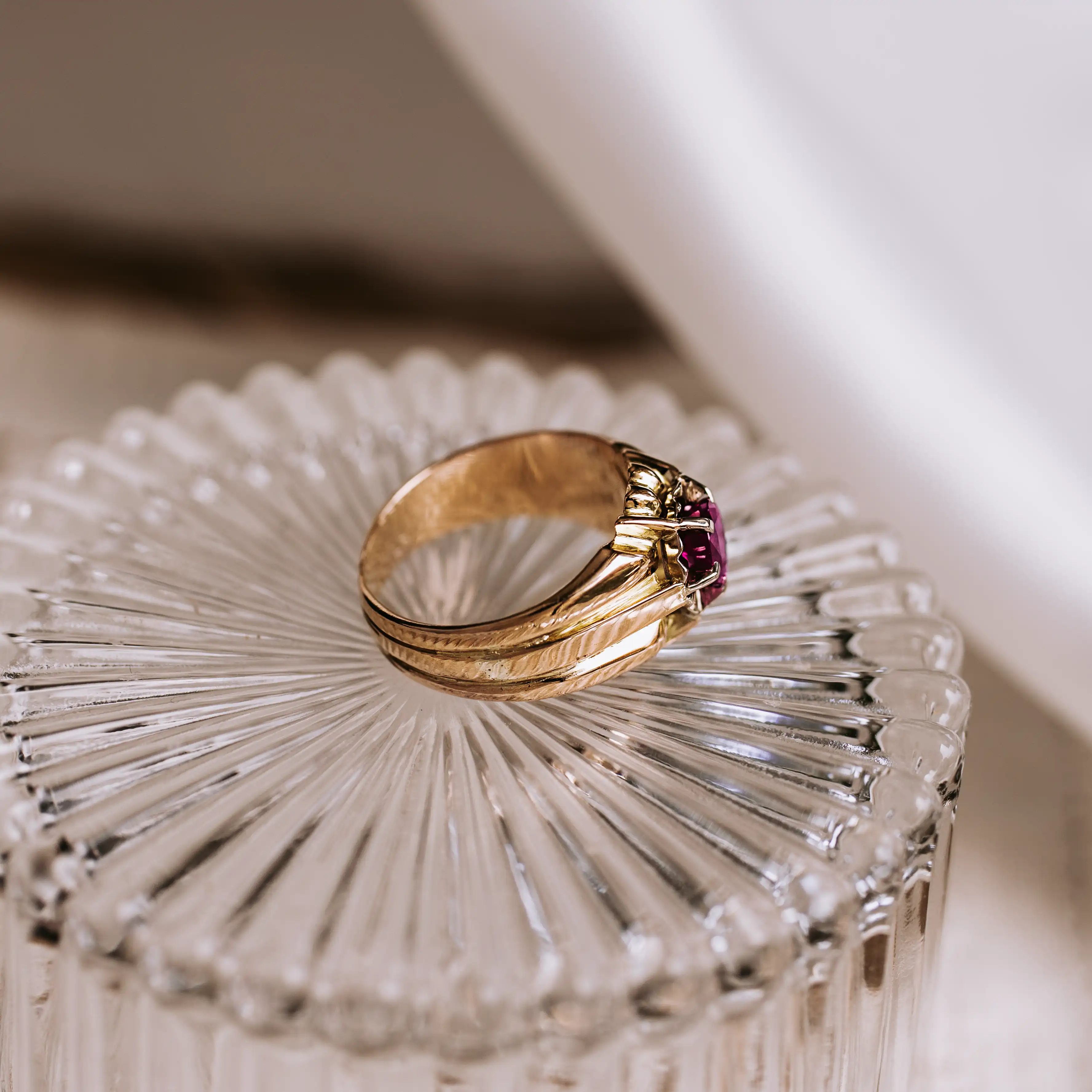
At Urbieta Antique, the ruby holds a special place within our selection of antique and vintage jewellery. Rings, earrings, brooches and other pieces reveal how jewellers from different periods used this gemstone to create extraordinary contrasts with diamonds, gold and other precious materials.
We select every piece individually, considering not only the beauty of its gemstones but also its setting, age, craftsmanship, condition and personality.
When a ruby has formed part of a jewel for decades, its value cannot be understood by examining the gemstone alone. The entire piece must be considered, together with the history it represents.
What Exactly Is a Ruby?
A ruby is a variety of the mineral corundum, just like sapphire. Its characteristic red colour is primarily caused by the presence of chromium within its structure.
Colour is one of the most important factors influencing the appearance and value of a ruby. Its shades can range from lighter reds to deep, intense tones, with varying degrees of saturation.
In addition to its extraordinary beauty, ruby is notable for its hardness. Corundum reaches 9 on the Mohs scale, second only to diamond, a characteristic that has helped make it particularly suitable for creating jewellery designed to endure.
However, at Urbieta Antique, we know that understanding an antique ruby requires more than studying its gemmological characteristics in isolation. The cut, setting, period and way in which the gemstone was incorporated into the jewel all provide essential information about each piece.
Ruby Colour: Much More Than Red
If there is one characteristic that immediately defines a ruby, it is its colour.
However, simply describing it as “red” would be an oversimplification of a gemstone with an extraordinary variety of nuances.
Rubies can display pinkish tones, intense reds and slightly purplish or orangey undertones. The combination of hue, saturation and brightness largely determines their overall appearance.
Historically, some of the most admired rubies have displayed vivid, deep-red colours capable of retaining their intensity under different lighting conditions.
Among the antique ruby jewellery selected by Urbieta Antique, we encounter precisely this diversity. Every gemstone has its own characteristics, and its setting can enhance its colour in an extraordinary way, especially when the ruby is accompanied by diamonds.
A Precious Gemstone with Centuries of History
The fascination with rubies dates back to antiquity.
For centuries, the ruby was associated with power, wealth and protection. Kings, aristocrats and prominent families incorporated rubies into crowns, rings, brooches and other precious objects, turning them into visible symbols of status and prestige.
Different cultures also attributed meanings related to vitality, passion and good fortune to rubies.
Their intense red colour inevitably encouraged these associations.
With the development of European jewellery, rubies began to feature prominently in some of the most characteristic designs of the 18th, 19th and 20th centuries. Each period interpreted the gemstone differently, adapting its settings, cuts and combinations to the prevailing styles of the time.
This historical journey is particularly fascinating to Urbieta Antique because it allows us to discover rubies in jewellery of many different styles, ranging from delicate, romantic pieces to bold geometric designs.

Rubies and Diamonds: A Historic Combination
One of the most recognisable combinations in antique jewellery is that of rubies and diamonds.
This is no coincidence.
The contrast between the intense red of a ruby and the brilliance of a diamond allows both gemstones to enhance one another. Diamonds bring light to the coloured gemstone, while the ruby immediately becomes the visual focal point of the composition.
This combination can be found in rings, earrings, brooches, bracelets and many other historic pieces.
Rosette designs are a good example: a central ruby may be surrounded by a halo of diamonds, creating a luminous floral composition. Rubies can also be found in trilogy rings, chevalier rings and other classic designs that we regularly feature in our selection.
At Urbieta Antique, we find these combinations particularly compelling when they preserve the balance and proportions of the original piece. In antique jewellery, an exceptional gemstone is important, but so is the way in which the jeweller integrated it into the overall design.
Rubies in Antique Jewellery
One of the reasons why buying an antique ruby jewel is so appealing is the opportunity to discover designs that no longer follow modern manufacturing conventions.
Handcrafted settings, stone-setting techniques, gemstone cuts and proportions reflect the methods and tastes of each historical period.
This means that two antique ruby rings that appear similar at first glance may prove entirely different when examined closely.
At Urbieta Antique, we select every piece individually. Before adding a jewel to our collection, we study it as a whole, examining its materials, construction, gemstones and condition.
We do not aim to offer dozens of identical pieces. In fact, this would be virtually impossible given our approach to antique jewellery.
We look for precisely the opposite: jewellery with identity.
How Is the Quality of a Ruby Assessed?
Assessing the quality of a ruby requires several characteristics to be considered together.
Colour is one of the most important factors. The gemstone’s hue, saturation and colour distribution must all be evaluated.
Its transparency and clarity must also be examined. Natural rubies may contain internal inclusions, but these do not necessarily indicate that a gemstone is of poor quality. In fact, certain inclusions can provide information about its formation and assist in its gemmological analysis.
The cut also plays an essential role, as it affects how the gemstone reflects light and displays its colour.
Weight, expressed in carats, is another relevant factor, particularly because large natural rubies of good quality are becoming increasingly exceptional.
Finally, the gemstone’s origin and any treatments it may have undergone can significantly influence its value.
When discussing antique jewellery, all these factors must also be considered within the context of the piece itself. At Urbieta Antique, we believe it is essential to assess both the gemstone and the jewel that has preserved it for decades.
Natural, Synthetic and Treated Rubies: What Is the Difference?
This is one of the most important questions when discussing rubies.
A natural ruby was formed in nature over millions of years. It may subsequently have undergone certain treatments intended to improve some of its characteristics.
A synthetic ruby, by contrast, is created in a laboratory. It has essentially the same chemical composition and crystalline structure as a natural ruby, but its origin is different.
There are also various treatments applied to natural rubies. Some have historically been accepted within the jewellery market, while others can significantly affect the gemstone’s value.
These characteristics cannot always be identified through visual observation alone. Gemmological knowledge and, where appropriate, specialist analysis are therefore essential.
This is another reason why, at Urbieta Antique, we emphasise the importance of professional advice when purchasing antique jewellery. Beauty is the first quality we perceive, but every jewel possesses many other characteristics that deserve to be understood.
What Does the Ruby Symbolise?
Throughout history, the ruby has primarily been associated with passion, love, energy, vitality and power.
Its intense red colour explains many of these interpretations.
It has also traditionally been regarded as a symbol of protection and prosperity and was associated for centuries with royalty and society’s most privileged classes.
Today, these associations are mainly cultural and symbolic, but they continue to contribute to the extraordinary appeal of this precious gemstone.
This is why antique ruby jewellery remains a particularly meaningful choice for gifts, anniversaries and important occasions.
Why Choose an Antique Ruby Jewel?
An antique jewel allows us to appreciate a ruby from an entirely different perspective.
You are not merely acquiring a precious gemstone. You are choosing a ruby that forms part of a setting created in another historical period and which has survived to the present day.
Some pieces feature artisanal techniques that have virtually disappeared. Others display combinations and proportions characteristic of a specific period. All of them possess a sense of singularity that distinguishes antique jewellery from pieces manufactured in series today.
Choosing antique jewellery also means giving new life to an existing piece and preserving an artistic and artisanal heritage that deserves to remain part of our culture.
For us, this is one of the greatest attractions of working with antique jewellery: we do not recreate its history; we preserve it and help it continue.
Buying Antique Ruby Jewellery from Urbieta Antique
The Urbieta Antique ruby jewellery collection consists of individually selected pieces chosen for their quality, uniqueness, design, craftsmanship and condition.
Due to the very nature of antique jewellery, our selection is constantly changing. A ring, pair of earrings or brooch may be entirely unique and, once it finds a new owner, it may not be possible to replace it with an equivalent piece.
We therefore recommend exploring our current selection of ruby jewellery or contacting our team if you are looking for a particular type of piece.
Our personalised advice will help you understand each jewel in greater depth, including its characteristics, gemstones, setting and all the details that make an antique piece different.
Choosing a ruby may begin with falling in love with its colour.
But choosing an antique ruby jewel means finding a piece in which gemstone, design, craftsmanship and history are inseparable.
And that is precisely the kind of jewellery we seek for Urbieta Antique.
Frequently Asked Questions About Rubies
A ruby is the red variety of the mineral corundum. Its colour is primarily caused by the presence of chromium and can display different shades and degrees of intensity. It has historically been one of the most highly valued gemstones in fine jewellery.
The characteristic red colour of a ruby is primarily caused by the presence of chromium within its crystalline structure. The quantity and distribution of certain elements influence the different shades that each gemstone may display.
Rubies have traditionally been associated with love, passion, vitality, power and protection. These interpretations originate from different historical and cultural traditions and continue to form part of the symbolism surrounding this precious gemstone.
Reliably distinguishing a natural ruby from a synthetic one, or identifying certain treatments, may require specialist gemmological analysis. Observing inclusions and other characteristics can provide useful information, but professional assessment is essential when precise identification is required.
A natural ruby forms in nature, whereas a synthetic ruby is produced in a laboratory. Although they may share essentially the same chemical composition and crystalline structure, their origins are different, and this factor significantly influences their value.
Many natural rubies contain inclusions as a result of their formation process. Their presence does not automatically indicate poor quality, and certain inclusions can provide important information for the study and identification of the gemstone.
Rubies with intense, vivid and well-saturated red colours are generally particularly prized. However, a ruby’s value depends on all its characteristics and not solely on a specific colour designation.
Yes. Corundum reaches 9 on the Mohs scale of hardness, second only to diamond. This makes ruby particularly suitable for rings and other jewellery intended for frequent wear, although every antique jewel should always be handled with the care appropriate to its age and setting.
It is advisable to consider the ruby’s characteristics and possible treatments, the quality of its setting, the precious metals used, its age, condition and any alterations made to the piece. At Urbieta Antique, we examine every jewel individually before adding it to our selection.
At Urbieta Antique, we select antique and vintage ruby jewellery according to the quality of its gemstones, design, authenticity, craftsmanship and condition. Because these are unique pieces, the availability of our collection changes constantly, and every new addition may be one of a kind.

