

Jewelry
1980s Jewellery: When More Was More
Oct
1980s jewellery is characterised by its voluminous designs, the prominence of yellow gold, two-tone combinations and the use of diamonds, rubies, sapphires, emeralds and other coloured gemstones. Wide rings, oversized earrings, bold bracelets and chain necklaces turned jewellery into the focal point of an outfit—an aesthetic that is once again highly relevant. At Urbieta Antique, we select original vintage jewellery from the 1980s and reinterpret some of its historic codes in the contemporary creations of Urbieta Originals.
After years dominated by more delicate aesthetics, the 1980s revived the taste for bold jewellery. Yellow gold acquired an extraordinary presence, shapes became larger, precious gemstones introduced colour and combinations of different gold tones helped create designs filled with contrast.
Decades later, many of those stylistic codes feel surprisingly contemporary once again.
At Urbieta Antique, where we constantly observe how designs from the past return and are reinterpreted from one generation to the next, the aesthetics of the 1980s hold a particularly interesting place. So much so that some of their most characteristic elements have inspired different pieces in Urbieta Originals, our collection designed today using historic jewellery types and references as its starting point.
Because 1980s jewellery is immediately recognisable.
But what made that decade so special?
What Was 1980s Jewellery Like?
If we had to summarise it in a single idea, it would probably be this: presence.
Jewellery increased in size and acquired greater volume. Designs were intended to be visible and to play an active role within an outfit.
We find rings with wide structures, statement earrings, oversized links, polished surfaces, bangles and combinations of coloured gemstones with diamonds. Yellow gold was one of the decade’s main protagonists, although two-tone designs and combinations capable of creating highly distinctive contrasts were also popular.
In opposition to extreme delicacy, the 1980s championed confident jewellery.
This boldness is precisely one of the reasons for its current revival.
At Urbieta Antique, we are particularly interested in recovering designs capable of transcending the period in which they were created. The aim is not to reproduce a decade literally, but to identify the elements that continue to work and reinterpret them from a contemporary perspective.

Gold: The Main Protagonist of 1980s Jewellery
Talking about 1980s jewellery inevitably means talking about gold.
Yellow gold in particular.
Golden surfaces acquired an enormous presence during the decade and were used in pieces with substantial proportions. The metal was no longer merely a support for the gemstones but became a fundamental part of the design itself.
Rounded volumes, geometric structures, polished surfaces and combinations in which the gold provided much of the visual impact all became prominent.
Combinations of yellow and white gold were also highly relevant, introducing contrast within the same jewel.
This interplay between different tones remains particularly interesting today and can also be found in some of Urbieta’s 1980s-inspired designs.
Our R5823 1980s-Style Half-Eternity Ring by Urbieta Originals, for example, combines yellow and white gold with a central brilliant-cut diamond and nine old-cut diamonds set along the shoulders, reinterpreting this aesthetic through our own understanding of jewellery.
Diamonds and Coloured Gemstones: The Combination That Defined an Era
The 1980s were not afraid of colour either.
Rubies, sapphires, emeralds and other gemstones appeared alongside diamonds in luminous compositions with great personality.
The contrast worked particularly well: the intense colour of the gemstones found a counterpoint of light in the diamonds, while the gold provided warmth and structure.
This is precisely one of the combinations we have chosen to revive in Urbieta Originals.
Our current collection includes 1980s-inspired half-eternity rings crafted in 18-carat gold and set with sapphires and diamonds, rubies and diamonds, emeralds and diamonds or topazes and diamonds. All of them are designed by Urbieta and made to order, with a choice of different gold finishes. One example is our R04B01 Sapphire Half-Eternity Ring by Urbieta Originals.
They demonstrate something we continually observe when working with antique and vintage jewellery: a good design can belong to a particular period without remaining trapped within it.
1980s Rings: Volume and Personality
Rings embody the spirit of this decade particularly well.
Designs became wider and more prominent on the hand. The metal acquired greater importance, while gemstones could be arranged to create lines, contrasts and bolder compositions than those seen in previous decades.
This world also includes half-eternity rings, an especially interesting jewellery type because they bring several gemstones together in a continuous composition without compromising comfort.
At Urbieta, we have used this precise reference to develop different Urbieta Originals pieces inspired by the 1980s.
Our sapphire version combines four round sapphires with ten diamonds. The ruby design maintains the same structure while changing the coloured gemstone, and we also offer versions with emeralds and topazes.
The inspiration comes from a particular decade.
The way they are worn, however, is entirely contemporary.

Size Matters: Earrings and Voluminous Jewellery
The aesthetics of the 1980s extended far beyond rings.
Earrings acquired considerable dimensions, bracelets became wider and necklaces were designed to occupy more visual space. Even apparently simple pieces used volume to generate presence.
This does not necessarily mean that everything was excessively ornate.
In fact, many designs achieved their impact through relatively simple forms executed on a larger scale: polished gold surfaces, curves, geometric shapes and bold structures.
This is one of the reasons why certain pieces of vintage 1980s jewellery are so easy to integrate into a contemporary wardrobe today.
A single piece can define practically the entire outfit.
Cluster Rings Were Also Reinvented in the 1980s
Something that particularly fascinates us at Urbieta is observing how the same jewellery type can be transformed according to the period.
The cluster ring, for example, has a history that long predates the 1980s. However, different decades reinterpreted it by modifying its proportions, gemstones and arrangement.
This interplay between tradition and reinterpretation is very present in Urbieta Originals.
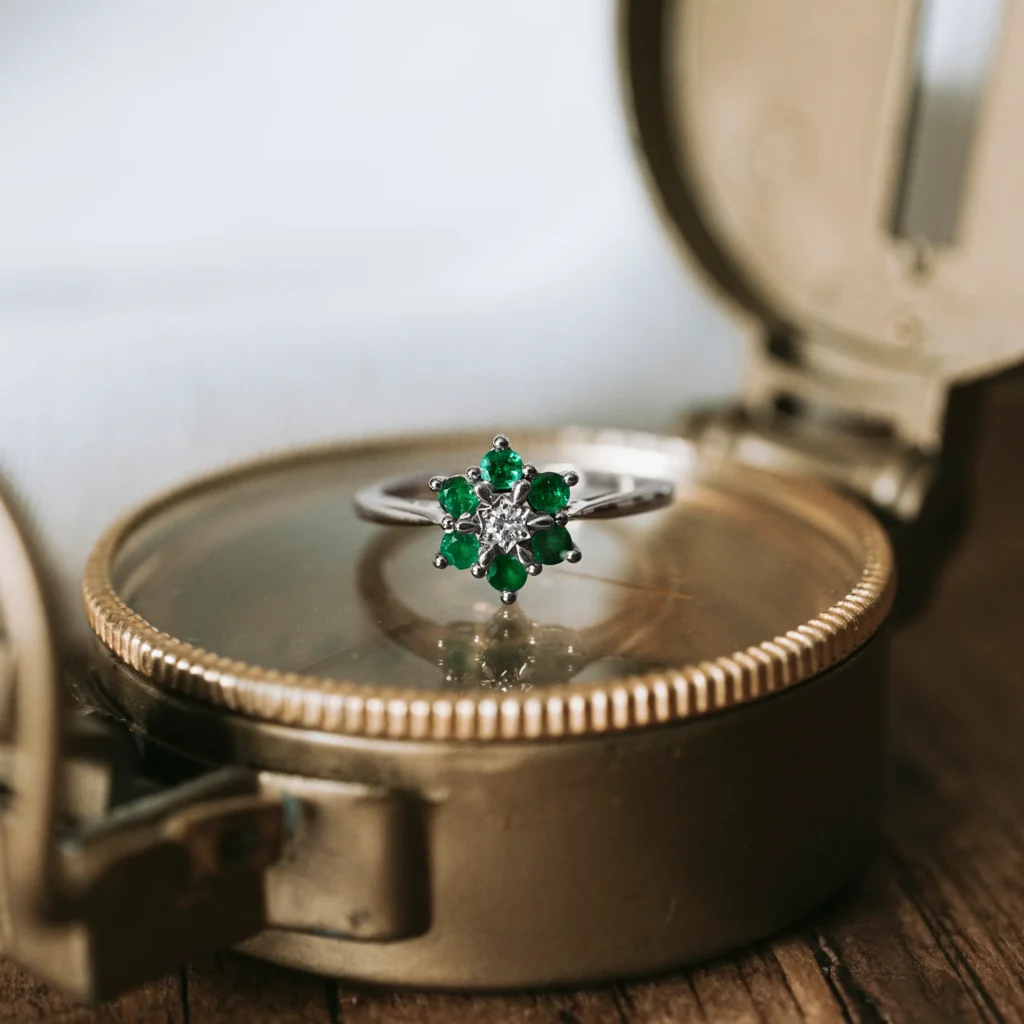
Our 1980s-style inverted cluster ring, for example, begins with a historic jewellery type but changes the way it is perceived through a composition in which an old-cut diamond is surrounded by a halo of coloured gemstones. Our current collection includes, among others, a version set with topazes.
This is precisely the type of creative exercise that defines our Originals collection: looking to the past to create a jewel intended to be worn today.
Why Is 1980s Jewellery Coming Back?
Fashion moves in cycles, but reducing the return of this aesthetic to a passing trend would only scratch the surface.
After years in which extremely minimalist jewellery predominated, interest has returned to pieces with greater personality: oversized earrings, bold rings, chains, yellow gold and coloured gemstones.
The way we combine jewellery has also changed.
Today, a jewel with a 1980s aesthetic does not need to form part of an outfit entirely inspired by that decade. On the contrary, it can be the element that disrupts an otherwise minimalist look.
A voluminous ring combined with simple clothing.
Oversized gold earrings worn with a white shirt.
A half-eternity ring set with coloured gemstones worn alongside contemporary rings.
At Urbieta Antique, we believe the best proof that a jewel has been well designed is its ability to leave behind the context in which it was created and remain interesting decades later.
Many pieces from the 1980s meet this condition perfectly.
How Can You Recognise an Authentic 1980s Jewel?
Aesthetics may provide clues, but appearance alone is not enough to date a jewel.
Certain designs associated with the 1980s were subsequently reproduced. Furthermore, some styles began earlier or continued into the following decade.
Studying a vintage piece requires a combined examination of its design, manufacturing techniques, metals, stone settings, hallmarks or maker’s marks when present, gemstones and condition.
It is also essential to distinguish between an original 1980s jewel and a contemporary piece inspired by that aesthetic.
At Urbieta, we are particularly clear about this distinction.
Our selection of antique and vintage jewellery includes original pieces from different periods, while Urbieta Originals consists of pieces currently designed by Urbieta and inspired by historic and vintage jewellery.
Both may share the same aesthetic language.
Their histories, naturally, are different.
Vintage 1980s Jewellery: What to Consider Before Buying
When purchasing a vintage piece, the decade in which it was created is only one of the factors we should consider.
At Urbieta Antique, we select every jewel individually, considering the quality of its materials and gemstones, its design, construction, condition and uniqueness.
We also analyse possible alterations or restorations and look for the piece to remain coherent with the period to which it belongs.
This is particularly important with relatively recent jewellery such as pieces from the 1980s. Simply being several decades old does not automatically make a jewel interesting.
Careful selection remains essential.
Our aim has never been simply to collect old objects.
We seek jewellery worth preserving.
Urbieta Originals: Reviving the 1980s Without Copying Them
Our relationship with the past does not end with the recovery and restoration of antique jewellery.
Urbieta Originals was created precisely from the possibility of using all this knowledge as a starting point for designing new pieces.
We study historic designs, techniques and jewellery types and recover the elements that continue to make sense today.
The aesthetics of the 1980s allow us to work with gold, diamonds, coloured gemstones and structures with considerable presence, while reinterpreting them through our own perspective.
This is why our pieces inspired by the decade are not intended to pass themselves off as antique jewellery.
They are contemporary jewels designed and created by Urbieta that openly acknowledge the source of their inspiration.
The difference is important.
And so is the connection.
Buying 1980s-Inspired Jewellery from Urbieta Antique
At Urbieta Antique, you can currently find different designs inspired by 1980s jewellery, alongside our constantly changing selection of antique and vintage pieces.
Within Urbieta Originals, we offer half-eternity rings set with diamonds and coloured gemstones, including versions with sapphires, rubies, emeralds and topazes, as well as two-tone designs that revive some of the decade’s most recognisable stylistic codes. You can discover them in our Urbieta Originals collection.
Originals pieces are made to order and certified.
Our team can help you whether you are looking for an original vintage jewel or prefer a contemporary creation inspired by the past.
At Urbieta Antique, we do not see decades as trends that disappear.
We see them as extraordinary archives of ideas worth revisiting.
And the 1980s still have a great deal to say.
Frequently Asked Questions About 1980s Jewelry
1980s jewelry was characterized by bold, voluminous designs featuring yellow gold, two-tone combinations, colored gemstones, and diamonds. Rings, earrings, bracelets, and necklaces played a starring role in personal style.
Voluminous rings, half-eternity bands, large earrings, chains, wide bracelets, and gold jewelry set with diamonds and colored stones—such as rubies, sapphires, and emeralds—were common.
Yellow gold was particularly prominent, though white gold and designs combining different gold tones within a single piece were also found.
Diamonds, rubies, sapphires, and emeralds frequently appear in jewelry associated with the decade's aesthetic. Other colored stones were also used to create contrast and visual impact.
Aesthetic style alone is not enough to date a piece of jewelry with certainty. It is necessary to examine its design, materials, manufacturing techniques, stone settings, hallmarks or stamps, and other characteristics. Professional analysis helps distinguish an authentic vintage piece from a reproduction or a later design inspired by the decade.

