

Jewelry
Baroque Pearls: The Beauty of Imperfection in a Unique Jewel
Oct
Baroque pearls are natural or cultured pearls with irregular, asymmetrical shapes, created by the way layers of nacre are deposited during their formation inside the mollusc. Each one possesses a unique silhouette, and its quality is assessed according to factors such as lustre, surface, colour, size and nacre quality. At Urbieta Antique, we select antique and vintage baroque pearl jewellery for its authenticity, organic beauty, craftsmanship and one-of-a-kind character.
Irregular, asymmetrical and virtually impossible to reproduce, each baroque pearl develops a different silhouette during its formation. No two are exactly alike, and perhaps this uniqueness explains why they have once again taken centre stage in contemporary jewellery.
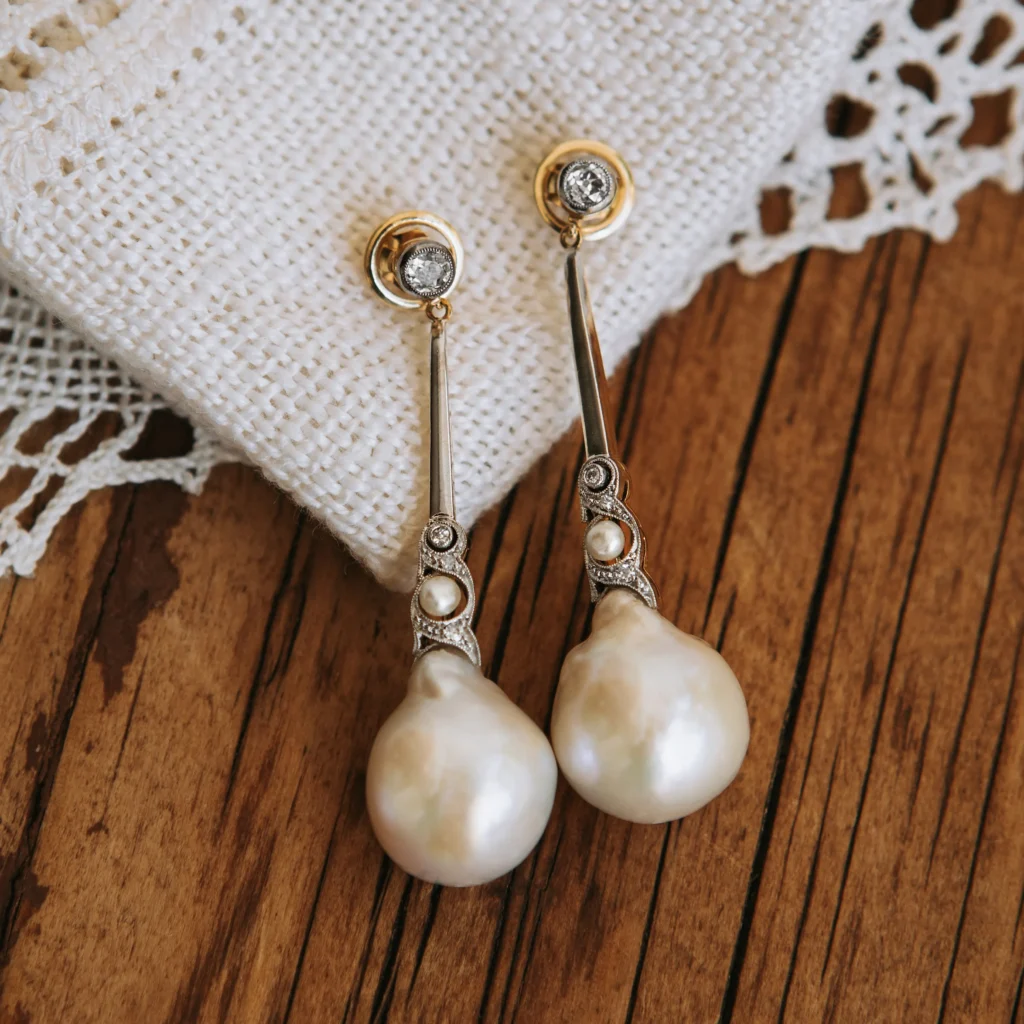
At Urbieta Antique, where the individuality of every piece is an essential part of how we understand jewellery, pearls regularly feature in our selection of antique and vintage pieces. Among them, we also find jewellery created with baroque pearls, such as our baroque pearl earrings—a perfect example of how an organically shaped gemstone can become the absolute focal point of a jewel.
But what exactly does it mean for a pearl to be baroque? Why does it develop these shapes? Is it less valuable than a round pearl? And how can we recognise a high-quality baroque pearl?
What Are Baroque Pearls?
A baroque pearl is a pearl with an irregular or asymmetrical shape, rather than the spherical geometry traditionally associated with a classic pearl.
It may be slightly oval, elongated or curved, display different volumes or adopt an entirely organic silhouette. Some have very subtle irregularities, while others develop extraordinarily sculptural forms.
That is precisely their defining feature: every baroque pearl is different.
Their appearance does not result from a mould or a predetermined design. It is created by the process through which the pearl forms inside the mollusc and the successive layers of nacre deposited around it.
This is why we find them particularly interesting at Urbieta Antique. We work with antique and vintage jewellery precisely because we seek objects with their own personality, and few gemstones represent this idea of uniqueness more effectively.
Why Do Baroque Pearls Have Irregular Shapes?
To understand this, we must first understand how a pearl forms.
A pearl develops when an element is present inside certain molluscs and begins to be covered by successive layers of nacre, composed mainly of calcium carbonate and an organic matrix.
In cultured pearls, this process is initiated through human intervention by deliberately introducing a nucleus or piece of tissue that stimulates pearl formation.
As the different layers are deposited, the pearl may develop more or less uniformly. When this growth does not produce a regular sphere, the shapes we describe as baroque appear.
The result may seem unpredictable, but it is precisely this lack of symmetry that gives every pearl its individual identity.
It is not, therefore, a “poorly formed” pearl.
It is another form of beauty.
Does Baroque Mean That the Pearl Is of Lower Quality?
Not necessarily.
This is probably one of the most important misconceptions to clarify.
Shape is one of the factors used to assess a pearl, but it is not the only one. We must also consider its lustre, surface, colour, size and nacre quality and, when it forms part of a jewel, the harmony between the different pearls and the design.
A baroque pearl can possess extraordinary lustre and an exceptionally beautiful surface.
Moreover, particularly attractive or unusual shapes may be precisely what makes a jewel so interesting.
At Urbieta Antique, we never assess a piece by considering just one parameter. We examine it as a whole: the pearls, setting, materials, period, design, craftsmanship and condition.
An exceptional jewel cannot be explained by a single characteristic.
Lustre: One of the Keys to a Fine Pearl
If there is one quality capable of completely transforming the appearance of a pearl, it is its lustre.
Lustre describes the way light interacts with the layers of nacre and is reflected back towards our eyes. In a high-quality pearl, the surface may produce well-defined reflections and a sense of depth that is difficult to imitate.
It should not be confused simply with shine.
A fine pearl appears to contain light within it.
This quality can be especially attractive in baroque pearls because their irregular surfaces cause light to reflect differently depending on the angle from which the jewel is viewed.
A baroque pearl can therefore change subtly as it moves.
This is one of those qualities that is difficult to appreciate fully in a photograph and explains why, at Urbieta Antique, we consider it so important to view a jewel in person whenever possible.
Natural and Cultured Baroque Pearls
Another concept that frequently causes confusion is the difference between a natural pearl and a cultured pearl.
A natural pearl forms without human intervention. They are extraordinarily rare, and certain antique natural pearls can achieve very high valuations.
Cultured pearls also form inside a mollusc, but their development begins through human intervention.
Therefore, a cultured pearl is a real pearl.
Both natural and cultured pearls can have baroque shapes.
This distinction is important because the terms describe different characteristics. “Baroque” refers primarily to the shape of the pearl, while “natural” and “cultured” indicate how its formation process began.
Are Baroque Pearls and Cultured Pearls the Same?
No.
A pearl can be both cultured and baroque.
In fact, many of the baroque pearls currently used in jewellery are cultured pearls that developed irregular shapes as they grew.
Cultured pearls can also be almost perfectly round, oval, drop-shaped or have other forms.
When choosing pearl jewellery, we should therefore avoid overly simplistic classifications.
Shape is only one of the many characteristics that should be examined.
From Antique Jewellery to the Catwalk: The Return of Irregular Pearls
For many years, the classical ideal of jewellery favoured perfectly round and carefully matched pearls.
However, irregular shapes never disappeared.
During different historical periods, jewellers knew how to take advantage of the natural characteristics of certain pearls to create designs in which their shape became an essential part of the composition.
Today, this way of understanding pearls has once again become highly relevant.
Contemporary jewellery has renewed its interest in organic surfaces, imperfect shapes and pieces that do not appear to have been produced identically hundreds of times.
This is where baroque pearls naturally find their place.
For Urbieta Antique, this revival makes perfect sense. One of the reasons antique jewellery continues to fascinate us is that it possesses small irregularities, artisanal techniques and distinctive features that make finding two identical pieces extremely difficult.
The baroque pearl embodies this idea from the very moment it is formed.
Baroque Pearls and Diamonds: The Perfect Contrast
One of the most interesting combinations in jewellery is that of pearls and diamonds.
The visual softness and pearlescent lustre of the pearl contrast with the defined sparkle of the diamond, creating particularly elegant compositions.
When the pearl is baroque, this contrast becomes even more compelling.
Its organic silhouette breaks with the geometry of the cut stones and gives the jewel a sense of movement and spontaneity.
The Urbieta Antique selection includes various pieces in which pearls and diamonds share the spotlight, from earrings and rings to pendants and other vintage jewellery.
These combinations demonstrate that pearls do not have to be associated solely with the classic multi-strand necklace.
How Can You Tell Whether a Baroque Pearl Is Authentic?
Distinguishing a genuine pearl from an imitation requires the analysis of several characteristics and, when precise identification is needed, the expertise of a specialist.
Real pearls have a layered structure and surface characteristics that differ from imitations made from glass, plastic or other materials.
Certain clues may be visible to the naked eye. Genuine pearls rarely have an entirely uniform surface and, particularly in baroque pearls, small natural characteristics are common.
However, no test performed at home can replace professional identification.
At Urbieta Antique, we apply the same philosophy to pearls as we do to diamonds, rubies and other gemstones: when purchasing a jewel of a certain value, it is important to understand what we are buying and to receive specialist advice.
What Urbieta Antique Considers When Selecting Pearl Jewellery
An extraordinary pearl may be the starting point for a great jewel, but for us, it is never sufficient on its own.
When selecting an antique or vintage pearl jewel, we assess the complete piece.
We consider the lustre, surface, shape, dimensions and characteristics of the pearls, but we also examine the setting, metals and other gemstones present, the quality of the stone settings, the design and the piece’s condition.
We also look for something far more difficult to measure: personality.
Our aim is not to stock a large number of similar jewels, but to find pieces capable of representing what defines our selection.
Well-made, interesting jewellery that is special enough to deserve a second life.
Baroque Pearl Earrings: A Unique Piece at Urbieta Antique
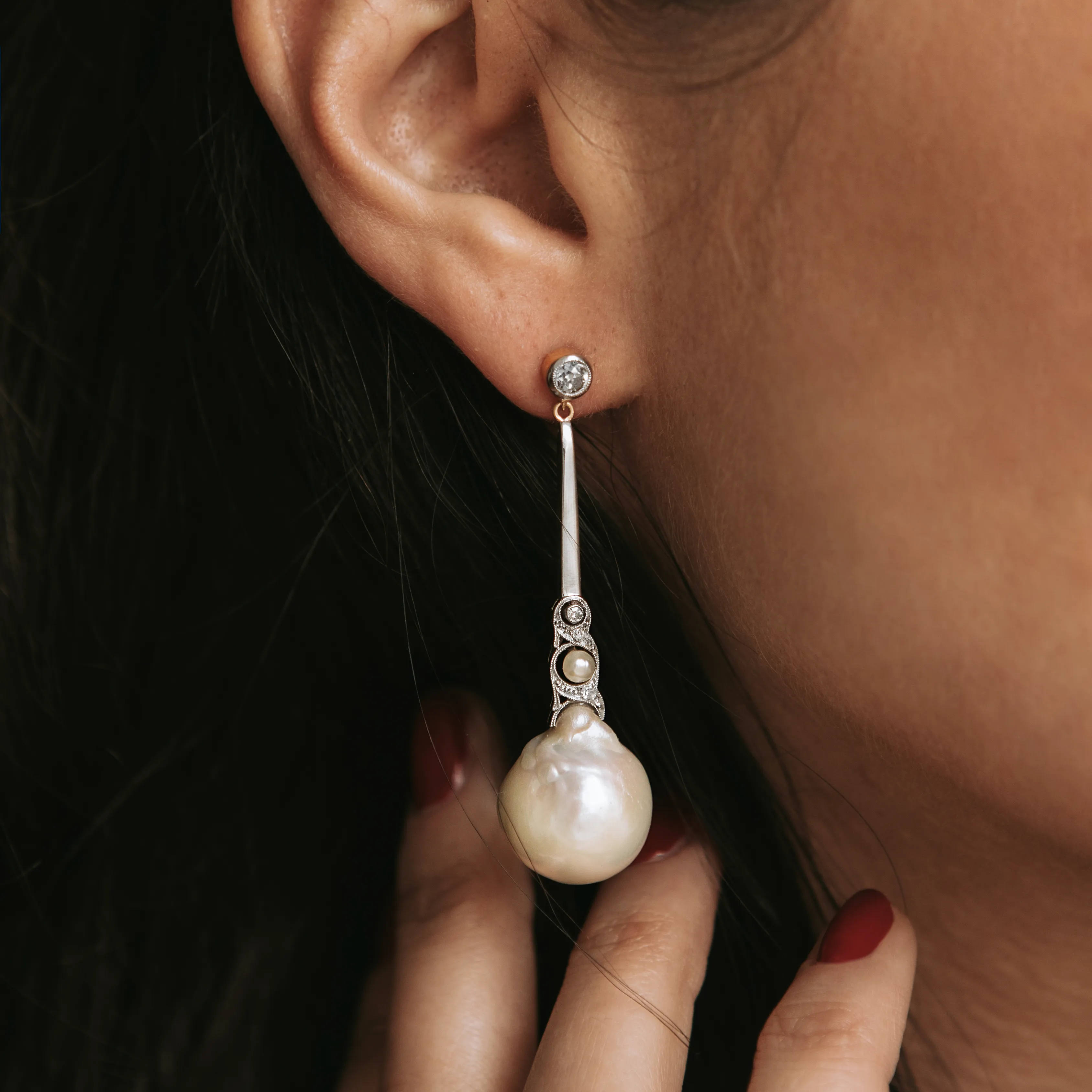
Our current selection includes an excellent example of this way of understanding pearls: our baroque pearl earrings, reference P6092.
In this piece, the natural irregularity of the pearls is no longer a secondary characteristic. Instead, it becomes one of the defining elements that give the design its personality.
This is something that particularly interests us.
When selecting an antique or vintage jewel, we do not necessarily seek geometric perfection. We look for proportion, beauty, quality and uniqueness.
A perfectly round pearl can be extraordinary.
A baroque pearl can be extraordinary too.
They simply speak different languages.
How to Wear Baroque Pearls Today
One of the reasons for the renewed interest in these pearls is probably their ability to move away from the more traditional image historically associated with pearl jewellery.
A pair of baroque pearl earrings can accompany an evening dress, but they can also be worn with a white shirt, a tailored suit, a minimalist dress or even a much more casual outfit.
They do not need to be reserved for special occasions.
In fact, combining them with contemporary clothing highlights precisely what makes them different.
They also work particularly well as a statement piece. A jewel featuring a uniquely shaped pearl may possess enough presence not to require many additional elements.
This versatility explains why many antique pearl jewels can appear surprisingly modern today.
Buying Pearl Jewellery from Urbieta Antique
The Urbieta Antique pearl jewellery collection includes earrings, rings, necklaces, pendants and other individually selected antique and vintage pieces.
Among them, we find classic designs alongside far more distinctive creations, including jewellery made with baroque pearls.
Our collection changes constantly because we work with unique pieces or designs that are difficult to replicate. Once a jewel finds a new owner, it is not always possible to replace it with an identical piece.
We therefore recommend exploring the selection available at any given time and consulting our team when looking for something specific.
We can help you understand its characteristics, materials, period and all the details that make every jewel special.
A baroque pearl does not need to be perfectly round to be extraordinary.
Perhaps it is precisely its imperfection that ensures no other pearl is exactly like it.
At Urbieta Antique, this uniqueness is precisely what we seek.
Frequently Asked Questions About Baroque Pearls
Baroque pearls are pearls with irregular or asymmetrical shapes rather than perfectly spherical geometry. They may develop oval, elongated, curved or completely organic silhouettes, and every example has its own distinctive characteristics.
Their shape develops as the pearl grows inside the mollusc. The successive layers of nacre do not always create a uniform sphere, giving rise to different shapes and volumes.
Yes. “Baroque” refers primarily to the pearl’s shape, not to whether it is genuine or artificial. A baroque pearl can be either natural or cultured.
They can be either. Both natural and cultured pearls may have baroque shapes. Today, many of the pearls used in jewellery are cultured.
Yes. A cultured pearl forms inside a mollusc through a genuine biological process, although its formation is initiated through human intervention. It should not be confused with an imitation pearl manufactured from other materials.

